Natural UHMWPE Fiber
refers to the white virgin yarn naturally produced during the manufacturing of ultra-high molecular weight polyethylene fiber.
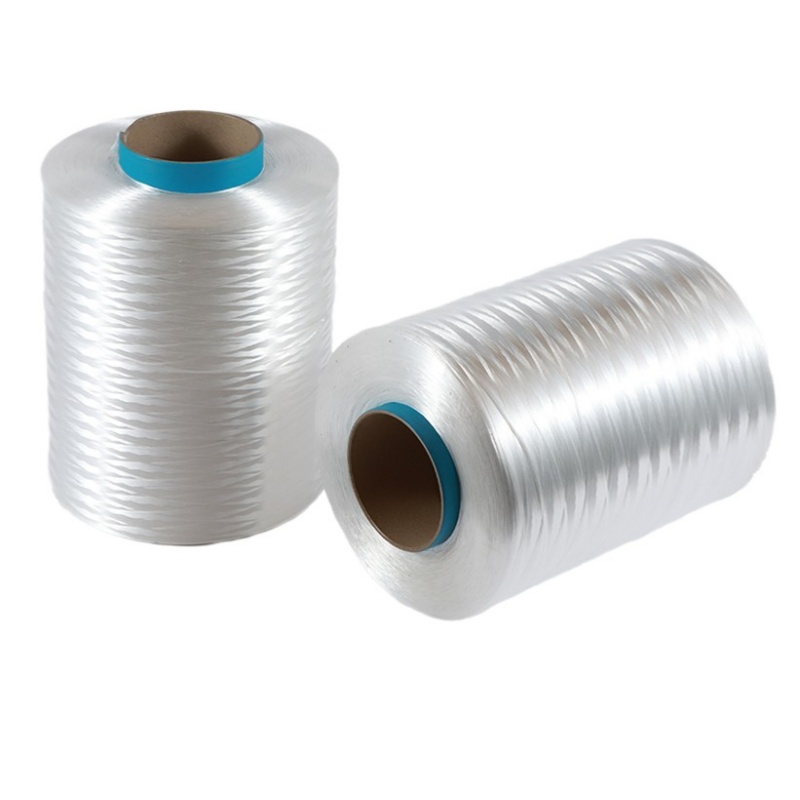
Natural UHMWPE Fiber
This product line includes standard fine filaments and standard coarse filaments,10D、15D、20D、25D、30D、40D、50D、75D、100D、… 、1600D. It comprehensively covers a full range of specifications and grades, offering versatile solutions for diverse industrial applications.
Features
UHMWPE fiber (Ultra-high molecular weight polyethylene fiber) is one of the world's highest specific strength and specific modulus fibers, recognized alongside carbon fiber and aramid fiber as one of the three major high-performance fibers globally. Its exceptional combination of properties—including low density, superior mechanical performance, outstanding impact resistance, and excellent abrasion resistance—positions it as a material of choice for demanding applications. Additionally, UHMWPE exhibits remarkable chemical corrosion resistance, UV resistance, low-temperature tolerance, and hydrophobicity, making it a versatile solution across industries.
Key Advantages:
l Ultra-Low Density:
With a density of 0.97 g/cm³ (lighter than water), UHMWPE offers unparalleled weight-to-performance advantages over other high-performance fibers.
l Unmatched Tensile Strength:
At the same linear density, UHMWPE fiber is 15 times stronger than steel wire, 40% stronger than aramid fiber, and 10 times stronger than premium steel or conventional synthetic fibers.
l Superior Impact Resistance:
UHMWPE absorbs energy and withstands deformation far more effectively than aramid or carbon fibers, delivering exceptional impact protection.
l Outstanding Wear Resistance:
Its abrasion resistance and bending fatigue performance surpass both carbon fiber and aramid fiber, ensuring long-term durability under harsh conditions.
l Ease of Processing:
UHMWPE’s exceptional flexibility and bending tolerance allow seamless integration into advanced composites, textiles, and engineered fabrics.
Application

| ITEM | UNIT | UHMWPE fiber |
| thick deniers | normal deniers | thin deniers |
| Linear Density | Denier | 1600 | 1200 | 1000 | 800 | 600 | 400 | 350 | 300 | 250 | 200 | 150 | 125 | 100 | 75 | 50 | 30 | 20 | 10 |
| dtex | 1776 | 1332 | 1110 | 888 | 666 | 444 | 388 | 333 | 275 | 222 | 165 | 139 | 111 | 83 | 55 | 33 | 22 | 11 |
| Tensile Strength | cN/dtex | ≥30 | ≥30 | ≥30 | ≥30 | ≥32 | ≥32 | ≥32 | ≥32 | ≥33 | ≥33 | ≥34 | ≥35 | ≥35 | ≥38 | ≥40 | ≥40 | ≥40 | ≥40 |
| Modulus | cN/dtex | ≥1100 | ≥1100 | ≥1100 | ≥1100 | ≥1200 | ≥1200 | ≥1200 | ≥1200 | ≥1250 | ≥1250 | ≥1300 | ≥1350 | ≥1350 | ≥1400 | ≥1500 | ≥1500 | ≥1500 | ≥1500 |
| Elongation | % | ≤3.5 | ≤3.5 | ≤3.5 | ≤3.5 | ≤3.0 | ≤3.0 | ≤3.0 | ≤3.0 | ≤3.0 | ≤3.0 | ≤3.0 | ≤3.0 | ≤3.0 | ≤3.5 | ≤3.5 | ≤3.5 | ≤3.5 | ≤3.5 |
| Density | g/cm³ | 0.97 | 0.97 | 0.97 | 0.97 | 0.97 | 0.97 | 0.97 | 0.97 | 0.97 | 0.97 | 0.97 | 0.97 | 0.97 | 0.97 | 0.97 | 0.97 | 0.97 | 0.97 |
| Filament | F | 480 | 480 | 480 | 240 | 240 | 160 | 160 | 120 | 100 | 80 | 60 | 60 | 40 | 30 | 20 | 15 | 10 | 10 |
| Melting Point | °C | 150 | 150 | 150 | 150 | 150 | 150 | 150 | 150 | 150 | 150 | 150 | 150 | 150 | 150 | 150 | 150 | 150 | 150 |
| Color available |
| yes | yes | yes | yes | yes | yes | yes | yes | yes | yes | yes | yes | yes | yes | yes | yes | yes | yes |